



 Own or work here?

Dan K Reports is an independent cannabis market research and policy analysis platform focused on separating data from industry narrative. Founded by Daniel Kief, the platform uses government-reported sales, pricing, and participation data to explain how legal cannabis markets actually function—and why many fail to meet expectations.
The research centers on a simple premise: measure real demand, pricing, and legal market capture using verifiable data, not assumptions. Dan K Reports challenges widely accepted industry benchmarks, including inflated consumption rates and total addressable market (TAM) estimates, offering more grounded models that materially change how market size and growth are understood.
A key contribution is the Black Market Death Equation (BMDE), a quantitative framework that evaluates how pricing, retail access, product availability, and regulatory friction determine whether consumers transition from illicit to legal markets. This model provides a practical lens for assessing policy effectiveness and market viability.
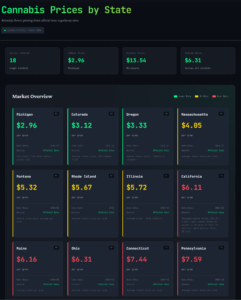
The platform publishes detailed state-by-state analyses highlighting structural issues such as under-licensing, price inflation, and supply constraints. Findings consistently show that competitive pricing and accessibility—not restrictive regulation—drive legal market success.
Dan K Reports also offers tools including TAM calculators, policy trackers, and market models used by operators, investors, and policymakers. All work is grounded in public data with a strong emphasis on transparency and methodological rigor.
The mission is straightforward: replace speculation with data and provide a clearer view of how cannabis markets truly operate.
Visit our site at: https://www.dankreports.com
What is the Black Market Death Equation (BMDE)?
The Black Market Death Equation (BMDE) is a quantitative policy model developed by Daniel Kief that predicts how much of a cannabis market will transition from illicit to legal channels.
At its core, BMDE measures legal market capture—the percentage of total demand served by licensed operators—based on a small set of real-world variables. These include:
- Price competitiveness (legal vs. illicit pricing)
- Retail access (store density and availability)
- Product quality and variety
- Consumer convenience (hours, payments, delivery)
- Enforcement of illicit markets
Each variable is weighted by its real-world impact, with price acting as the dominant factor. If legal cannabis is materially more expensive than illicit alternatives, legal markets consistently fail to capture demand—regardless of other improvements.
The model combines these inputs into a single “utility score,” which translates into a predicted legal market share. In practical terms, BMDE answers a simple but critical question:
Will consumers actually switch to the legal market—or not?
Unlike traditional industry analysis, which often assumes demand automatically migrates post-legalization, BMDE demonstrates that policy design directly determines outcomes. Markets with competitive pricing and sufficient access can approach full legal capture, while restrictive, high-cost systems leave the majority of demand in the illicit market.
The framework is used to:
- Evaluate state cannabis policies
- Forecast market performance
- Model the impact of regulatory changes (e.g., taxes, licensing, enforcement)
In short, BMDE provides a data-driven explanation for why some legal cannabis markets succeed—and why many fail.
Rate us and Write a Review
September, 2026
Sunday
DAY OFF
August 26,2019
- Tuesday
- 9:00am - 10:00am
Appointment confirmation email will be sent upon approval.
Awesome Job!
We have received your appointment and will send you a confirmation to your provided email upon approval.


